Die Tatsachen liegen auf dem Tisch


The performative installation „Die Tatsachen liegen auf dem Tisch“ (The Facts Are on the Table) explores the relationship between community and memory, grounded in a stance of attentive listening. It is a site-specific work that engages with the nature and history of its location: the cultural hall of an independent cultural center. The hall was built between 1939 and 1942 as part of a complex originally constructed as an armaments factory where forced labor was carried out. The hall also served as the venue for a 1949 show trial the Goehle-Werk Trial in which the director and the overseers of the female forced laborers were prosecuted.
Die Tatsachen liegen auf dem Tisch seeks methods of accessing the past that go beyond mere historical information, conceiving of memory as body, sound, and matter.
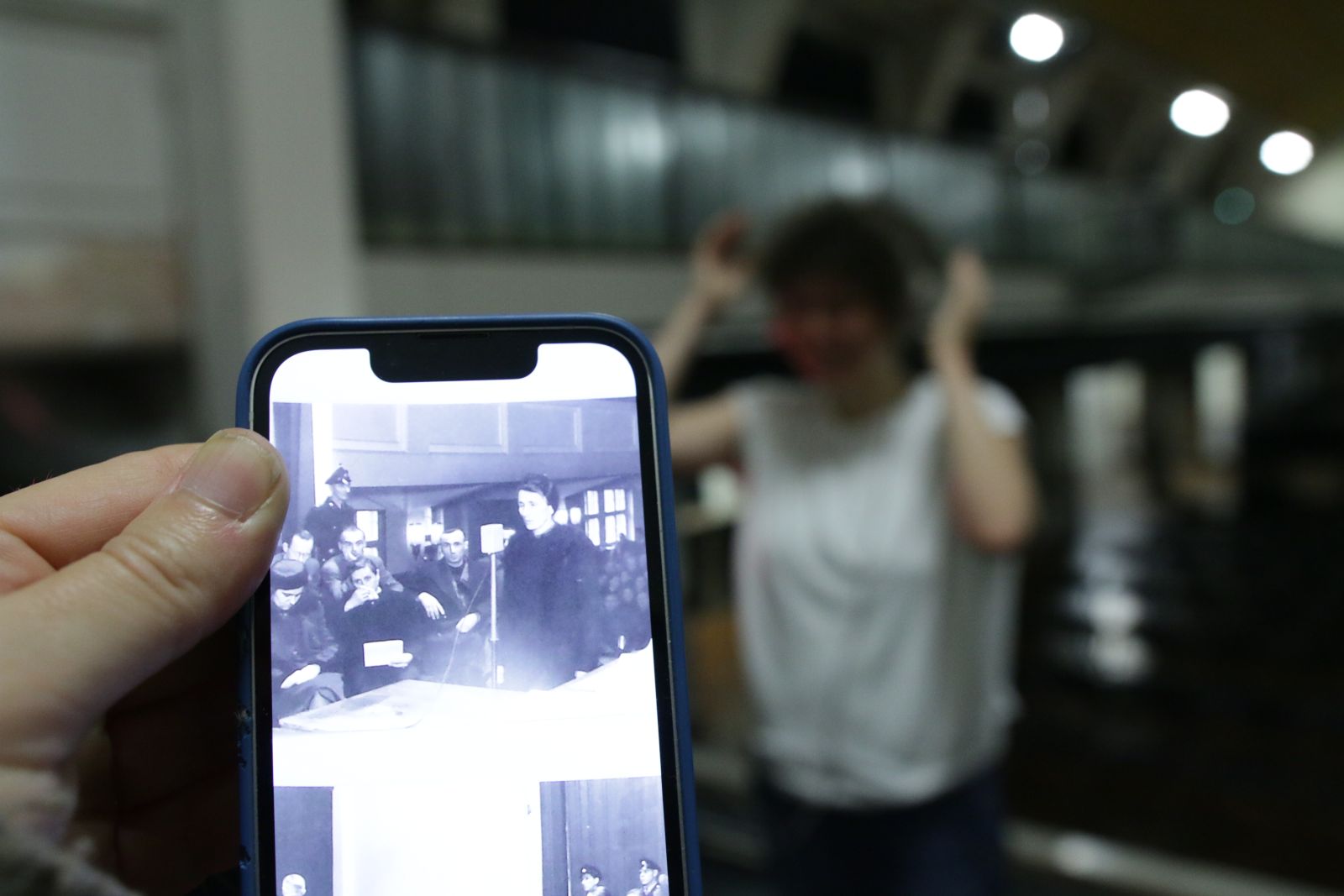
The work combines video projection with an encounter between the performer and the audience in a shared space in front of the screen. Here, visitors and a performer meet. Together, they examine various materials laid out on a table: handwritten texts; a pair of headphones emitting voices which the audience is not permitted to wear; and historical alongside contemporary photographs taken at the very same location documentary images and reenactments that can be discovered independently while leafing through a photo album.
The video projection shows four people at a table engaging with various materials (metal, wood, fabric, water) and tools. The image appears and disappears, repeatedly bringing the sound to the fore during the moments of blackness. When the image vanishes, the performer—having put on the headphones begins to move; she is the one allowed to listen, and she translates what she hears.
Context of the creation of the work Cantieri in Movimento: Industrial Heritage Soundscapes
„Die Tatsachen liegen auf dem Tisch“ (The Facts Are on the Table) was created as part of Cantieri in Movimento 2022: Boarding Pass, funded by the Italian Ministry of Culture. It was a collaborative project involving Zō Centro Culture Contemporanee (Italy), Curva Minore (Italy), Zentralwerk (Germany), Nova Synagoga (Slovakia), and the IZOLYATSIA Foundation (Ukraine).
Between January and October 2022, project participants worked both online and through short residencies at each location to capture local history and the industrial context, incorporating these elements into their performances. On-site, the selected artists were able to develop and present artistic reflections on the history and heritage of these places. Working in groups of three, the artists created five site-specific works that premiered in Catania in September 2022.
The creation of „Die Tatsachen liegen auf dem Tisch“ (2022)
Initial ideas emerged following discussions about the history of the space and the specific nature of the culture of remembrance in Dresden. The team sought materials capable of generating a soundscape, aiming to use them productively in a participatory performance that engaged with relics of the past.
WORKING WITH MATERIALS AS PROCESS-ORIENTED MEMORY WORK
Friederike Altmann happened to be developing a site-specific project at Zentralwerk that addressed the history of female forced laborers at Ravensbrück and the Goehle-Werk factory. She typically works alone, creating visual pieces and material collages that explore both the origins and the materiality of objects. When Daniela and Barbara met with her to discuss potential materials, they ultimately decided to collaborate. They invited Friederike to participate in the filming sessions held during Aldo Scarpitta’s residency at Zentralwerk in July 2022.


For the first time, she would be working alongside others and sharing her experience-based approach to memory with them. At the same time, the collaboration allowed Altmann to further develop her own artistic practice and discover the significance of sound as well as the potential of her work to resonate with others.
The video and audio recording of the experience took place in the large hall at Zentralwerk. Friederike and three other individuals sat at the table. During the editing process, the decision was made to omit certain visuals at times, allowing the sound more space to unfold.
A NON-MUSEUM APPROACH TO ARCHIVAL MATERIALS
The research materials were provided by the Dresden City Museum: photographs from the 1949 Goehle-Werk trial and audio recordings from 1969 concerning the same subject had been sourced by Barbara beforehand and were available for use.
Daniela and Barbara reenacted several scenes captured in the trial photographs. Daniela took on the role of a specific person from the photos, while Barbara sought out the exact spot where the photographer had stood. This process proved to be an intensely emotional undertaking. The audio recordings from 1969 a kind of retrospective on the Goehle-Werk trials held twenty years latercannot be used publicly due to privacy rights. This inspired Barbara to adopt a performative approach to the existing material: Daniela would listen to the recordings and translate them into movement.
The audio recordings from 1969 a kind of retrospective on the Goehle Works trials held twenty years later cannot be used publicly due to privacy rights. This inspired Barbara to adopt a performative approach to the existing material: Daniela would listen to the recordings and translate them into movement.
During a second joint stay in Palermo, Daniela, Barbara, and Aldo assisted by Marieluise Herrmann prepared an album of photos from the reenactments and drafted a fragmentary text, intended to be handwritten and presented to the audience.
THE PERFORMATIVE INSTALLATION
The performative installation offers a way to combine these various approaches into a coherent artistic work. This process involved decisions regarding spacing, timing, and lighting, all of which were discussed and agreed upon collectively by the Zentralwerk group. During the performance, the audience is confronted with the organized material and having shared an initial moment of discovery gradually immerses themselves in the subject matter at their own pace. Thanks to the DIY aesthetic and presentation style, the act of engaging with memory is experienced as a composition that unfolds over time.
RE-ENACTING THE AUDIENCE: A continuation of the project
The aim is to further develop this initial experiment into a participatory practice.
In particular, there is an opportunity to reenact a historical scene involving a group of people (school students) who were photographed in the immediate vicinity of the courtroom during the 1949 trial: passersby standing at the corner of Heide- and Riesaer Straße, listening to the public broadcast of the proceedings

___________
Die performative Installation „Die Tatsachen liegen auf dem Tisch“ verhandelt die Beziehung zwischen Gemeinschaft und Erinnerung, ausgehend von einer Position des aufmerksamen Zuhörens. Sie ist eine ortsspezifische Arbeit, die sich mit der Beschaffenheit und der Geschichte des Ortes auseinandersetzt: Der Kultursaal eines unabhängigen Kulturzentrums. Erbaut wurde er zwischen 1939 und 1942 in einem als Rüstungsfabrik entstandene Baukomplex, in dem Zwangsarbeit geleistet werden musste. Der Saal war auch Austragungsort eines Schauprozesses in dem 1949 der Direktor und die Aufseher*innen der Zwangsarbeiterinnen angeklagt wurden: der Goehle Werk Prozess.
„Die Tatsachen liegen auf Tisch“ sucht nach Methoden über die historischen Informationen hinaus auf die Vergangenheit zuzugreifen und begreift Erinnerung als Körper, Klang und Materie.
Ortsunspezifisch verbindet die Arbeit eine Videoprojektion und die Begegnung mit dem Publikum in einem geteilten Raum vor der Leinwand. Hier begegnen sich Besucher*innen und eine Performerin. Gemeinsam betrachten sie verschiedene Materialien, die auf einem Tisch liegen: handgeschriebene Texte, ein Kopfhörer aus dem Stimmen erklingen – den das Publikum nicht aufsetzen darf – historische und aktuelle Photographien, die am selben Ort entstanden: Dokumentarfotografien und Reenactments, die beim Blättern in einem Fotoalbum eigenständig entdeckt werden können.

Die Videoprojektion zeigt vier Menschen an einem Tisch, die sich mit verschiedenen Materialien (Metall, Holz, Stoff, Wasser) und Werkzeuge beschäftigen. Das Bild erscheint und verschwindet, so dass der Klang durch das schwarze Bild immer wieder in den Vordergrund rückt. Wenn das Bild verschwindet, setzt sich die Performerin in Bewegung, nachdem sie die Kopfhörer aufgesetzt hat: Ihr ist es erlaubt zu hören: sie übersetzt.
KONTEXT der Entstehung der Arbeit Cantieri in Movimento. Industrial Heritage Soundscapes
„Die Tatsache liegen auf dem Tisch“ entstand im Rahmen von Cantieri in Movimento 2022 Boarding Pass gefördert vom Italienischen Ministerium für Kultur. Ein Kooperationsprojekt. von Zō Centro Culture Contemporanee (Italy), Curva Minore (Italy), Zentralwerk (Germany), Nova Synagoga (Slovakia) and IZOLYATSIA foundation (Ukraine)
Die Projektteilnehmer arbeiteten zwischen Januar und Oktober 2022 online und in Form von kurzen Aufenthalten an jedem der Orte, um die lokale Geschichte und den industriellen Kontext zu erfassen und in ihren Performances zu verwenden. Dort konnten die ausgewählten Künstler*innen Reflexionen über die Geschichte und das Erbe dieser Orte künstlerischer entwickeln und präsentieren. In Gruppenkonstellationen von drei Künstler*innen entstanden fünf ortsspezifischen Arbeiten die in September 2022 in Catania Premiere feierten.
Die Entstehung von „Die Tatsachen liegen auf dem Tisch“ 2022
Nach Gesprächen zu Geschichte des Raumes und über die Besonderheit der Gedenkkultur in Dresden entstanden erste Ideen. Das Team suchte nach Materialien, die eine klingende Landschaft erzeugen können, um sie für eine partizipative Performance im Umgang mit Relikten der Vergangenheit produktiv zu machen.
UMGANG MIT MATERIALIEN ALS PROZESSORIENTIERTE ERINNERUNGSARBEIT


Friederike Altmann war zufällig dabei, im Zentralwerk ein ortsspezifisches Projekt zu entwickeln, das sich mit der Geschichte der Zwangsarbeiterinnen in Ravensbrück und im Goehle Werk beschäftigt. In der Regel arbeitet sie allein und entwickelt visuelle Arbeiten, Materialcollagen, die sich sowohl mit der Herkunft als auch mit der Materialität der Objekte auseinandersetzen. Als Daniela und Barbara sich mit ihr trafen, um sich über mögliche Materialien beraten zu lassen, beschlossen sie schließlich zusammenzuarbeiten. Sie luden Friederike ein, an den Dreharbeiten während der Residenz von Aldo Scarpitta im Juli 2022 im Zentralwerk teilzunehmen.
Zum ersten Mal würde sie sich zusammen mit anderen Menschen an die Arbeit machen und ihren erfahrungsbasierten Ansatz zum Thema Erinnerung an andere weitergeben. Gleichzeitig entwickelte Altmann durch die Zusammenarbeit ihren eigenen künstlerischen Ansatz weiter und entdeckte die Relevanz von Klängen und des Potenzials der eigenen Arbeit für anderen Menschen neu.
Die Aufzeichnung von Video- und Tonmaterial des Erlebnisses fand im großen Saal des Zentralwerks statt. Friederike selbst und drei weitere Personen nahmen am Tisch Platz. Die Entscheidung im Schnitt war, die Bilder teilweise auszusparen, um dem Ton mehr Raum zur Entfaltung zu geben.
DER NICHT-MUSEALE UMGANG MIT ARCHIVMATERIALIEN
Die Recherchematerialien wurden vom Museum der Stadt Dresden zur Verfügung gestellt: Fotografien vom Goehle-Werk Prozess aus dem Jahr 1949 und Tonaufnahmen aus dem Jahr 1969 zum gleichen Thema waren in Vorfeld von Barbara recherchiert worden und standen zur Verfügung.
Daniela und Barbara stellten einige fotografierten Situationen des Prozesses nach. Daniela verkörperte als Darstellerin eine bestimmte Person auf den Fotos, während Barbara nach der genauen Position des Fotografen vor Ort suchte. Dieser Prozess war in der Tat eine intensive emotionale Arbeit.
Die Tonaufnahmen aus dem Jahr 1969, eine Art Rückblick auf die Goehle Werk Prozesse 20 Jahre später, können aus Gründen des Persönlichkeitsrechts nicht öffentlich genutzt werden. Das inspirierte Barbara zu einem performativen Umgang mit dem vorhandenen Material: Daniela würde die Aufnahmen anhören und sie in Bewegung umsetzen.
Beim zweiten gemeinsamen Aufenthalt in Palermo haben Daniela, Barbara und Aldo mit der Hilfe von Marieluise Herrmann ein Album mit den Fotos der Reenactments vorbereitet und einen fragmentarischen Text verfasst, der handgeschrieben und dem Publikum vorgelegt werden sollte.
DIE PERFORMATIVE INSTALLATION
Die performative Installation ist eine Möglichkeit, die verschiedenen Ansätze in einer kohärenten künstlerischen Arbeit zu kombinieren. Dazu gehörten Entscheidungen über Abstand, Timing und Beleuchtung, die die Zentralwerk-Gruppe gemeinsam diskutierte und traf. Während der Aufführung wird das Publikum mit dem geordneten Material konfrontiert und taucht langsam und individuell in das Thema ein, indem es sich auf einen gemeinsamen ersten Moment der Entdeckung eingelassen hat. Durch die DIY-Ästhetik und -präsentationsweise, wird die Erinnerungsarbeit als eine Komposition erlebt, die sich nach und nach entfaltet.
RE ENACTING the AUDIENCE: eine Fortsetzung des Projektes
Dieses erste Experiment soll als partizipatorische Praxis weiterentwickelt werden.
Insbesondere bietet es sich an, eine historische Situation mit einer Gruppen von Menschen (Schüler*innen) nachzustellen, die 1949 während des Prozesses in unmittelbaren Nähe des Saales fotografiert wurde: Passantinnen standen an der Ecke Heide-Riesaaer Strase und lauschten die öffentliche Übertragung des Prozesses
